

By Torlando Hakes, President, Craftsman Painter
In the contracting world, the WhatsApp groups and Facebook forums tell a familiar story every year as the seasons change. The confident swagger of the summer peak gives way to the anxious chatter of the fall slowdown. “Where are my leads?” “Who moved my cheese?” “Is anyone else’s phone dead?”
This panic is predictable. And in this environment, the most common reaction is to double down on short-term, expensive lead-generation tactics, hoping for a quick fix.

Work Directly with Torlando Hakes
Skip the color choice stress. Work directly with me as your personal Color Designer to select the perfect architectural palette for your home, and get a Complementary Color Consultation when you purchase paint through us.
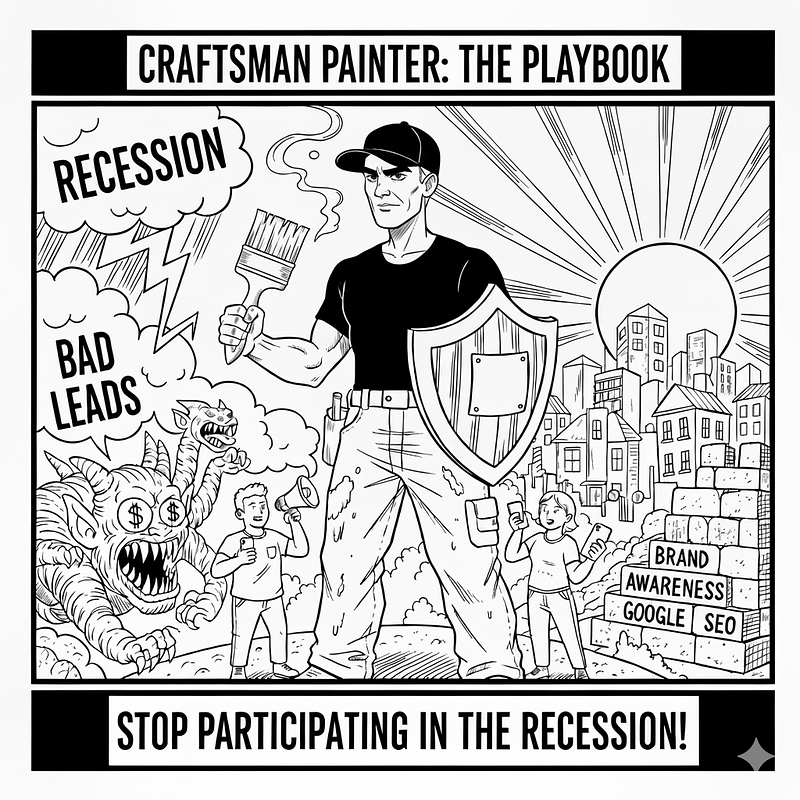
But as I recently discussed with my peers in our Collective Coaching Sprint, this panic-driven approach is a strategic error. It’s what my friend Tom Reber calls “participating in the recession.”
There might be a slowdown, but we’re not going to participate in it.
The reality is that most contractors are wasting money because they’re trying to force a shot with a bad play. They’re optimizing for the wrong customer and burning cash on short-term “lead gen” ads that attract impulsive, low-quality, tire-kicking clients. This craters closing ratios and reinforces a scarcity mindset.
To build a resilient, all-weather business, you must shift from a reactive, short-term mindset to a strategic, two-front system. This is the playbook we’re implementing: a synchronized war for market dominance built on Demand Generation and Demand Capture.
The Fallacy of the Forced Shot
Let’s look at the common mistake. A contractor sees their pipeline drying up. In a panic, they log into Meta (Facebook) and set up a “Lead Generation” campaign. Meta’s algorithm dutifully goes to work finding people in the local area most likely to fill out a form right now.
Here’s the problem: Who are these people?
They are often the most impulsive, least-qualified, and most price-sensitive segment of the market. They are not the discerning clients who have been planning a $10,000 project. As a result, your sales team (or you) spends all day chasing leads with a 5% close rate. If you pay $50 per lead, you might spend $1,000 to acquire a single, low-margin $1,500 job. The math simply doesn’t work.
This is what I call “forcing the shot.” In basketball, you don’t just inbound the ball and immediately heave a 3-pointer with two defenders in your face. You run a play. You set up the offense. You create an open look.
Marketing is no different. The lead-gen ad is the forced shot. The strategic playbook is how you get wide open.
The New Playbook: A Two-Front Marketing War
Instead of hunting for leads one by one, we must focus on building a system that makes us the only logical choice when a client is ready to buy. This requires a two-pronged strategy.
Front 1: Demand Generation (The Air War)
The Goal: Build “mental availability” and massive brand recall.
The Strategy: Broad, top-of-funnel brand awareness campaigns.
Your goal here is not to get a lead. It is to get the cheapest possible impressions and the highest possible frequency. We want every homeowner in our market to see our brand 3–4 times, associating us with high-quality painting.
Think about insurance. There is zero differentiation between State Farm, Geico, and Progressive. They sell a commodity. They win by spending billions on brand awareness so that when you think “insurance,” their jingle plays in your head.
We must do the same, just on a local scale.
The Playbook:
- Channel: Meta (Facebook/Instagram), YouTube.
- Campaign Objective: “Brand Awareness” or “Reach.”
- Bidding: Optimize for CPM (Cost Per Thousand Impressions), not Cost Per Lead. You should be aiming for a CPM under $5.
- Targeting: Go broad. In my small market, I target “35 and older,” and that’s it. Forget hyper-targeting income or interests; it will drive your costs up and limit your reach.
- The Goal: Achieve Ad Recall Lift. You want people to see your content — your videos, your job site photos — so many times that when they do enter the buying phase, your name is the first one they think of.
As I’ve been running this play, the results are undeniable. My website’s direct traffic — people who physically type “craftsmanpainter.com” into their browser — is up 200% year-over-year. That’s not an accident. That is mental availability in action.
Front 2: Demand Capture (The Ground War)
The Goal: Convert active buyer intent into booked estimates.
The Strategy: Build an impenetrable “defensive perimeter” where buyers go to search.
While your “Air War” is building recall, your “Ground War” is positioned to capture the demand you’ve created. This is where your customer, who now remembers your brand, goes to validate their choice and take action.
The Playbook:
- Channel: Google (Search, Map Pack/GMB, Local Service Ads).
- The Synergy: This is the most critical part. Your brand awareness campaign makes all your “Ground War” efforts cheaper and more effective. Why? Because a homeowner will go to Google and type “painters near me.” They will see three ads, the map pack, and the organic listings.
- If they don’t know you, they’ll click the first ad, costing you $50.
- If they do know you (from your Air War), they will see your ad, skip it (saving you money), and scroll down to find your organic listing or your Google Business Profile. They were already looking for you.
Tactics:
- Google Business Profile (GMB): This is your single most important demand-capture asset. As my colleague Carlos noted, “It’s organically. It’s just my time… to collect those reviews.” A profile rich with recent, 5-star reviews is non-negotiable.
- Local Service Ads (LSA): These “Google Guaranteed” ads are often more affordable and effective than standard search ads, especially when buyers already recognize your brand.
- Offline Capture: This includes all the traditional, high-ROI tactics. Put out yard signs. Canvas neighborhoods. Leave door hangers. As Derek Barnes, a master of this, would attest, knocking on 10,000 doors builds a business. If you won’t knock, at least leave your card.
Managing the Machine: The “Accordion Principle”
This two-front marketing system fills your pipeline. But it’s useless if you can’t manage the workflow. This brings us to the final piece of the strategic puzzle: seasonal staffing.
The painting business is seasonal. Trying to keep a full summer staff busy in January will bankrupt you. As Carlos mentioned, it “hurts the profit” and “bites you in the back.”
We’ve adopted what I call the “Accordion Principle.”
The legendary contractor John Nubert once told me he scales from 75 painters in the summer down to a core 25 in the winter. He expands and contracts like an accordion. This requires a new way of thinking about your team:
- Your A-Team (The Core): These are your year-round, full-time project managers and lead painters. In the summer, they manage crews. In the winter, they put the brush in their hand and execute your most profitable interior jobs.
- Your B-Team (The Flex Force): These are your reliable seasonal painters, part-time employees, and college students. They understand the deal. They provide the surge capacity for the summer rush and are the first to have their hours reduced in the fall. You must be transparent with them about this reality from day one.
- Your Bench (The Subcontractors): As I do, you should have a bench of vetted, insured sub-crews. My model is three W2 employees and nine sub-crews on the bench. This allows me to have “twice as many paint crews as I have the demand for,” ensuring I can always deliver on tight deadlines without carrying the overhead.
This strategic alignment of marketing (filling the funnel) and operations (flexing the accordion) is what creates a resilient business. You stop being a victim of the season and become the master of your market.
This is the shift we must all make. Stop participating in the recession. Stop forcing the shot. Run the playbook, build the brand, and capture the demand that is already there.
 After
After Before
Visualize Your Space with Color Studio AI
Planning a project? Skip the paint chip guesswork. Use our Color Studio AI to instantly visualize these paint colors on your own walls, or take advantage of our aligned contractor pricing matching current Sherwin-Williams retail promotions.
Book Your Upcoming Paint Project
Craftsman Painter is now scheduling premium transformations. Secure your spot and elevate your property value.
Get an EstimateHelp Others Find Professional Color Insights
Share this story directly to your networks or copy the link to share with friends.