

By The Craftsman Painter Collective
In the modern trades industry, technical proficiency — knowing how to spray a cabinet door or mitigate bleed-through — is merely the price of entry. The true differentiator between a struggling contractor and a scalable enterprise lies in the mastery of three invisible pillars: digital leverage, emotional intelligence, and financial discipline.
Recent strategic sprints by the Craftsman Painter Collective reveal a sector in transition. As contractors navigate the “peaks and valleys” of seasonality, they are simultaneously grappling with the commoditization of lead generation and the psychological traps of pricing in a high-inflation environment.

Work Directly with Torlando Hakes
Skip the color choice stress. Work directly with me as your personal Color Designer to select the perfect architectural palette for your home, and get a Complementary Color Consultation when you purchase paint through us.
The following analysis dissects the core challenges facing today’s service entrepreneurs and offers a framework for “stacking days” to build enduring value.
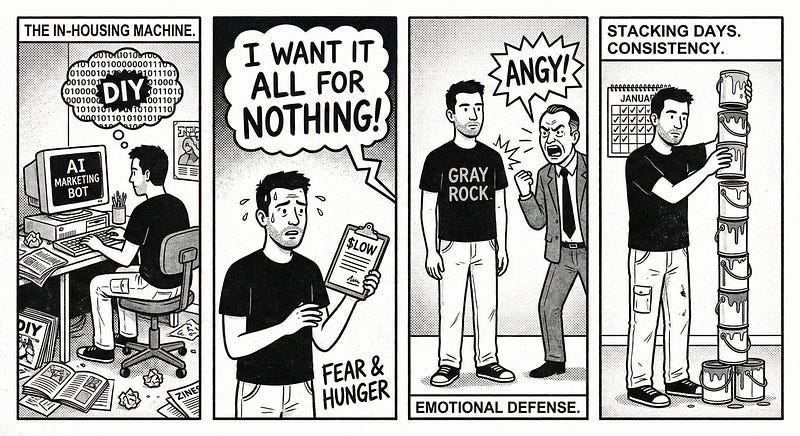
I. The In-Housing of the Marketing Machine
For years, the standard playbook for residential service businesses was to outsource digital presence to agencies. However, a shift is occurring. Contractors are increasingly reclaiming control over their digital assets, driven by the realization that generic agency strategies often yield high Customer Acquisition Costs (CAC) and low-quality leads.
The AI Advantage
The democratization of Artificial Intelligence has removed the technical barrier to entry for self-managed marketing. As noted during the collective’s January sprints, operators are now using tools like ChatGPT and Gemini not just for copywriting, but for sophisticated coding and SEO strategy.
The “Gem” Strategy:
rather than treating AI as a generalist tool, savvy operators are creating specific “Gems” or custom instruction sets. One “Gem” might be trained exclusively on technical scope-of-work documents, while another is fed specific data on Google Ads performance to analyze counter-intuitive trends.
By feeding these systems evidence-based research and specific business data, contractors can generate:
- Local Schema Markup: Code snippets that help Google identify service areas without needing a developer.
- Ad Copy Iteration: Rapid A/B testing of headlines and hooks for Facebook and Google campaigns.
- Landing Page Optimization: Moving away from generic “forms” to integrated, high-trust landing pages that reduce friction and increase conversion rates.
The “Brand Search” Defense
As competition heats up, “counter-attack” advertising has emerged. Competitors are bidding on branded keywords — literally buying ad space against a rival’s company name.
While this can be flattering, it requires a defensive strategy. The most cost-effective countermeasure is running a “Brand Search” campaign. By bidding on their own name, companies ensure they dominate the top of the search results, neutralizing competitors who attempt to siphon off high-intent traffic.
II. The Psychology of Pricing: “Fear and Hunger”
Perhaps the most critical insight from the collective is the direct correlation between pricing confidence and operational chaos. Low pricing does not just reduce margins; it attracts a specific demographic of customer that disproportionately consumes management bandwidth.
The “Cheap” Trap
There is a distinct causality chain identified by the collective:
- Fear and Hunger: When lead flow slows (winter months), owners act out of scarcity.
- Price Concession: To win the bid, they lower prices or agree to unreasonable scope.
- Scope Creep: Customers who buy on price often value the work the least and demand the most.
- Operational Failure: The budget is too tight to absorb inevitable mistakes, leading to conflict.
As Torlando Hakes, a lead voice in the collective, noted: “The reason we say yes when we shouldn’t is because of fear and hunger… When we have a small budget, we don’t have room for mistakes. But every job is full of mistakes.”
High margins act as a shock absorber. They allow a business to correct errors without panic, maintaining a calm, professional atmosphere that generates referrals.
Emotional Regulation: The “Gray Rock” Method
When projects inevitably hit turbulence — whether due to unrealistic customer expectations or technical failures — the entrepreneur’s reaction is the final line of defense.
The collective advocates for the “Gray Rock” method of conflict resolution.
- Be Boring: Do not absorb the customer’s chaotic emotion (be a rock, not a sponge).
- Detach: Recognize that their anger is theirs; your professional response is yours.
- BIFF Response: Keep communication Brief, Informative, Friendly, and Firm.
III. Strategic Consistency: “Stacking Days”
In an industry prone to “shiny object syndrome” — chasing the newest marketing fad or service vertical — boring consistency is the ultimate competitive advantage.
Borrowing from high-performance sports psychology, the goal is not to win the championship today, but to “stack good days.” This means adhering to the mundane inputs that drive output:
- Consistent Outreach: Leaning into architects and designers rather than waiting for General Contractors (GCs) to hand out scraps.
- Financial Visibility: Utilizing sliding-scale calculators to track leads, closing rates, and average job size against annual revenue goals.
- Brand Discipline: Ensuring that the digital footprint matches the physical work. A premium price requires a premium digital presentation.
The Verdict
The modern craftsman cannot afford to be just a technician. They must be a data analyst, a negotiator, and a stoic leader. As the January sprints highlighted, the contractors who will thrive in 2026 are not necessarily the ones with the best brush skills, but the ones who can master their own psychology and leverage technology to escape the “time-for-money” trap.
The path forward is clear: Pick a lane, master the tools, and stack the days.
 After
After Before
Visualize Your Space with Color Studio AI
Planning a project? Skip the paint chip guesswork. Use our Color Studio AI to instantly visualize these paint colors on your own walls, or take advantage of our aligned contractor pricing matching current Sherwin-Williams retail promotions.
Book Your Upcoming Paint Project
Craftsman Painter is now scheduling premium transformations. Secure your spot and elevate your property value.
Get an EstimateHelp Others Find Professional Color Insights
Share this story directly to your networks or copy the link to share with friends.