

How to Fix Your Labor Budget Without Sacrificing Quality
It’s a scenario I see constantly in my coaching sessions with fellow business owners: we’ve got just enough jobs coming in, but cash flow is still tight and profits are shrinking. This frustrating situation, which I call the “Profitability Paradox,” is almost always rooted in a single, critical area of the business: production inefficiency. The silent killer of otherwise healthy companies is the consistent, project-by-project drain from labor budgets that are misaligned with performance.
The fundamental problem is that most compensation models reward the wrong metric: hours logged. When you pay for time, you get time. When you want to get performance, you must pay for performance.
Based on a recent intensive coaching sprint with a group of dedicated painting contractors, I’ve distilled a three-part strategic framework designed to resolve this paradox. It moves beyond simple management tactics to re-engineer the very systems that govern your profitability. This playbook will show you how to:

Work Directly with Torlando Hakes
Skip the color choice stress. Work directly with me as your personal Color Designer to select the perfect architectural palette for your home, and get a Complementary Color Consultation when you purchase paint through us.
- Establish a Financial Baseline using the “Value Stick” framework.
- Align Incentives with a performance-based “Points System.”
- Integrate Quality Assurance through a “Dual-Incentive Bonus Model.”
The Anatomy of a Profitable Project: The Value Stick Framework
Before you can solve a problem, you must accurately diagnose it. The “Value Stick” is a strategic tool for visualizing the financial anatomy of any project. It measures the space between the customer’s willingness to pay (WTP) — the maximum price the market will bear for your value proposition — and the painter’s willingness to sell (WTS) their labor. The primary function of your firm is to create and capture the value within that space.
Through industry analysis and coaching, we’ve established clear benchmarks for where each dollar of revenue should be allocated.
- Labor: 40%
- Materials: 15%
- Sales Commission: 7–10%
- Marketing & Customer Acquisition (CAC): 8–15%
- Overhead & Net Profit: ~25%
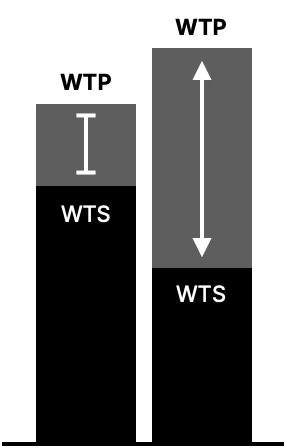
The profit goal of a business is to drive a bigger wedge between their Willingness To Pay and their Willingness to Sell. Ask: How can we make it worth it for customers to choose us and for our team to stay with us? (Hint: Money is NOT the only driver)
If your labor costs are consistently exceeding the 40% benchmark, you are not merely over budget; you are eroding your net profit and transferring value from the company directly to inefficiency.
The Monday Morning Audit: A Strategic Diagnostic
To begin, you must confront the data.
- Analyze Your Last 5 Projects: Pull the detailed financial reports for your five most recently completed jobs.
- Calculate Actual Percentages: For each project, determine the precise percentage of revenue consumed by labor, materials, and other direct costs.
- Identify the Leak: Compare your results to the benchmarks above. This data will provide an objective, undeniable starting point for the strategic changes that follow.
Re-engineering Compensation: From Paying for Time to Paying for Performance
The traditional hourly pay model is fundamentally flawed for a production environment because it creates no incentive for efficiency. A painter who finishes a job in six hours earns less than one who takes eight, punishing the very behavior you want to encourage.
The solution is to adopt a sophisticated piece-rate model. The “Points System” is a framework that achieves this by standardizing tasks and directly linking pay to output.
The Mechanics of the Points System:
- Standardize the Unit of Work: Define 1 Point as the amount of work a trained apprentice can complete in 1 hour. This baseline is crucial; it creates an objective, company-wide standard for productivity, rather than relying on the speed of your top performer.
- Establish the Point Value: The monetary value of one point is your company’s minimum viable starting wage. During our session, one contractor identified this as $20/hour. Therefore, in his company, 1 Point = $20. In different regions, this could be as low as $15 or as high as $25.
- Implement the Pay Structure: The core of the system is this payment rule: Employees are paid for points earned OR hours worked, whichever is greater.
This structure is strategically brilliant for two reasons. First, it provides a safety net, guaranteeing employees their base wage and protecting them from unforeseen project delays outside their control. Second, and more importantly, it creates an incentive for high performers.
A skilled painter can produce far more than one point per hour. If they complete a 4-point task (budgeted for 4 hours) in just 2 hours, they still receive the full value of 4 points ($80 in this example). Their effective wage for that period becomes $40/hour. This transforms labor from a passive time-tracking exercise into an engaging, performance-driven activity where individuals have direct control over their earning potential.
The Dual-Axis Incentive Model: Balancing Speed with Quality
The predictable risk of any performance-based pay system is a potential decline in quality and customer service. A crew singularly focused on speed may cut corners, damaging your brand’s reputation — your most valuable asset.
Therefore, you must create a compensation model that operates on two axes: speed and quality. The “Review Bonus” is a powerful tool for achieving this alignment.
The Concept: A significant financial bonus is awarded to the crew for each project that meets two non-negotiable criteria:
- Profitability: The job must hit its target labor budget (e.g., ≤ 40%).
- Reputation: The customer must provide a 5-star public review.
The Implementation: A bonus of 5% of the total contract value is a strong motivator. On a $10,000 project, this is a $500 cash bonus distributed among the crew. This bonus is not a “nice to have”; it is an essential component of the system.
This model transforms your production team from laborers into active stewards of the company’s reputation and profitability. They are no longer just painting walls; they are manufacturing 5-star reviews and protecting the bottom line, because they now have a direct financial stake in both outcomes.
Implementation and Leadership: Turning Theory into Field Reality
A brilliant strategy is useless without disciplined execution. Making this system work requires clear communication and unwavering management.
- Clarity is Non-Negotiable: Every project must begin with a detailed work order that outlines each task and, crucially, the number of points budgeted for its completion. This document is the roadmap to success and the objective standard for performance.
- Translate for Your Audience: The way you communicate the budget must be tailored to your labor force. For W2 employees, talk in points. For subcontractors, who often think in terms of day rates, translate the budget into man-days. A $4,000 labor budget on a $10,000 job equals roughly 11–12 man-days. This reframing makes the time constraint tangible and actionable for them.
- Embrace Cultural Evolution: Be prepared for resistance. As I told the contractors in my group, when you shift to a performance-based culture, you will likely lose some people. Do not view this as a failure. A performance-driven system naturally selects for individuals who are accountable, efficient, and aligned with the company’s goals. It is a necessary step in building a truly high-performing organization.
To resolve the Profitability Paradox, you must evolve from being a manager of projects to being an architect of systems. By integrating the Value Stick framework for financial clarity with a dual-axis compensation model that rewards both efficiency and quality, you create a self-sustaining production engine. You align the financial interests of every team member with the health of the business, fostering a culture of ownership that drives profits and builds an impeccable reputation.
 After
After Before
Visualize Your Space with Color Studio AI
Planning a project? Skip the paint chip guesswork. Use our Color Studio AI to instantly visualize these paint colors on your own walls, or take advantage of our aligned contractor pricing matching current Sherwin-Williams retail promotions.
Book Your Upcoming Paint Project
Craftsman Painter is now scheduling premium transformations. Secure your spot and elevate your property value.
Get an EstimateHelp Others Find Professional Color Insights
Share this story directly to your networks or copy the link to share with friends.