

The SPRINT Goals Playbook: A Guide to Goal Setting for Painting Professionals
Running a painting business isn’t always easy. In fact, it’s mostly not easy. Seems like it should be, but it’s not. The reality is there are many moving parts and emotions can run high, fatigue is constant, and setbacks that are largely out of your control pop up almost daily. While there is no magic bullet to make this business easy, engaging your entire team in goal setting can at least rally everyone around a common goal. Achievement is the cornerstone of your team culture so that you can rejoice when the mission has been accomplished.
As it turns out, we might have gotten the interpretation of the phrase “culture eats strategy for breakfast” all wrong. The research suggests that team culture isn’t the cause of successful teams. It’s the other way around. Teams that have “strong culture [often arrive there] as a result of a period of high performance” (“Beware the Sirens of Management Pseudo-Science”, Harvard Business Review, Vermeulen, Freek). If culture eats strategy for breakfast, then your team better be eating their Wheaties because strategy is the breakfast of champions. The strategy that you employ for goal setting matters.
The SPRINT Goals framework provides a structured approach to define, track, and ultimately achieve your team’s objectives.

Work Directly with Torlando Hakes
Skip the color choice stress. Work directly with me as your personal Color Designer to select the perfect architectural palette for your home, and get a Complementary Color Consultation when you purchase paint through us.
What are SPRINT Goals?
The most tried and true framework for setting goals is the SMART framework, and for good reason. It works. But it’s also old and a little boring…and I didn’t write a book called SMART, I wrote a book called SPRINT, so this is my self-indulgent way of spicing things up while staying true to research. It’s virtually the same, but with a couple of modifications that I find helpful and aligned with successful teams.
I’ve turned SPRINT into an acronym that outlines the key components of effective goal setting:
Specifications
Clearly define your goal, detailing the desired outcomes and the steps required to achieve them. Start with the big picture, and then get out a piece of paper or a white board and start writing down what you want the end picture of this goal to look like. Write several iterations. Take several days to write and iterate if you need to. The more you process this, the better the final outcome will be. Rapidly write down these ideas. Then distill it down to a short description that aligns best with your overall objective. Write it like you would a specification for a work order.
You want to have a clear picture of what success looks like in the end. I often call this my “wave a magic wand” scenario, which says, “if I could wave a magic wand over this, and it would look exactly how I want it to today, what would it look like?”
Performance Driven
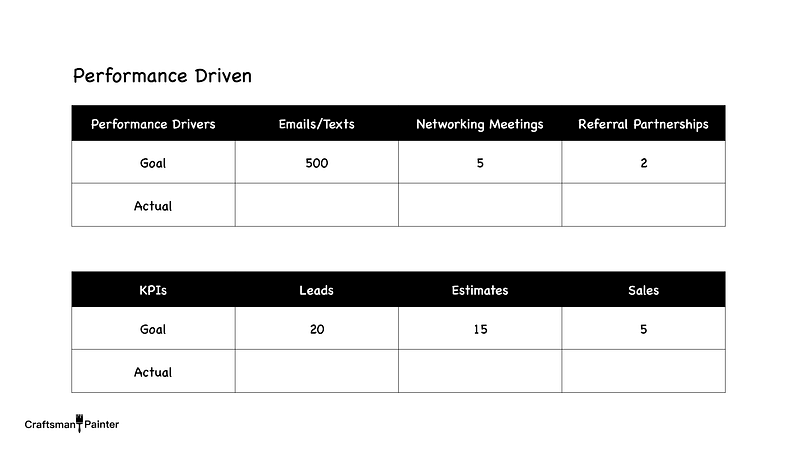
Identify Performance Drivers and Key Performance Indicators (KPIs) to track progress and assess performance. Performance Drivers and KPIs are what The 4 Disciplines of Execution (McChesney, Covey, et al.) call leading and lagging measures. In other words, Performance Drivers are the things you can measure that lead up to successful outcomes, and the KPIs are the measurements of outcomes that lag behind the activities that make up your performance drivers. Performance drivers are all the activities that are in your control, while the KPIs are the outcomes that flow from the performance drivers.
Making your goals performance driven means holding yourself and your team accountable to the performance drivers and monitoring the KPIs to ensure that you’re doing the right performance drivers. A field marketing example would be having a performance driver of the number of doors knocked, while a KPI would be the number of people who answered the door. Notice that while you can’t control the number of people who answer the door, you can control the number of doors that you knock on. It’s the analysis of these two measurements that improves performance.
You could look at the disparity between doors knocked and doors answered and consider ways to bring them closer together. If you were to knock on 20 doors and only 2 answered, you might be knocking at a time of day when people are not home. So find a better time to knock when more people are home. Now, let’s say that you’ve miraculously achieved parity between doors knocked and doors opened. Well, out of those 20 people, not all of them became leads or jobs. So keep digging. Are you knocking on random doors in a neighborhood with low turn over? Or are you knocking on doors of recent move-ins?
Never stop looking for ways to optimize your performance drivers. They are the only things in your control. You can’t control whether someone chooses to purchase from you. You can’t control whether a customer is happy with your work product. But what you can control are the things that typically lead to successful outcomes. Understanding the power of a performance driven goal will make your goals more attainable than anything else.
Reachable
Ensure your goal is ambitious yet attainable, based on your team’s capabilities and historical performance. Evaluating whether your goal is reachable builds on your goal being performance driven. You have to know what’s happened in the past to know what’s possible for the future.
I’ve only been employed at two companies where I was a salaried member of the company. I liked the companies, but alas, it’s the life of an entrepreneur for me. In both instances, I was on team “get the work” (meaning, marketing, and sales). My first move at both companies was to analyze the sales history because their first question was what was my goal for sales. But how could I know what’s possible if I don’t know what’s been done?
Surely, I’ll try to blow the history out of the water, but if I have no clue what has been done, anything I say would be a tragic guess that will only make me look bad. Either, I’ll unknowingly set the goal too low and look like an underachiever, or I’ll set the goal way too high and become an underachiever.
So you have to go back to past KPIs and performance drivers and reverse engineer the math formula (i.e. this many sales, came from this many calls, which came from this many leads, which came from this many lead sourcing activities). Therefore, if we want a 25% increase in sales, we need to see how increasing our output of lead sourcing activities by 25% does, and then evaluate if there is enough time in the day to even do that. If there is not, then you have to adjust your goal or go back to strategy and evaluate optimal activities or evaluate whether you’re staffed adequately for your company goals.
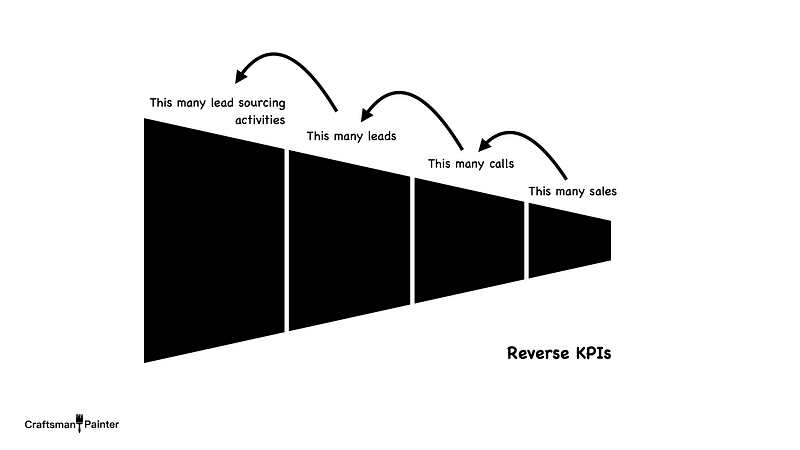
The same logic applies for production. You may want to increase production by 25%. That either means every person on your crew has to be able to increase their production rates by 25%, or you have to increase your production staff by 25%. Going back into the Performance Drivers and KPIs will tell you whether individual output is possible or not.
For production crew, we look at hours worked (performance driver) and points produced (KPI). Their production rate will be points per hour. However, you want to track production time versus time clocked-in. You’ll notice that team members will track more clocked-in hours than time spent on production tasks. A certain level of down-time or time during task-switching should be expected. But the closer task time and clocked-in time comes to complete parity, the more profitable each job will become. Dividing the task time by the clocked-in time will give each person an efficiency percentage (e.g. 35 hrs task time divided by 40 hrs clocked-in time equals .875 or 87.5% efficiency).
If you look at your overall team efficiency, and they have an efficiency greater than 75% percent, then a 25% percent increase in productivity isn’t possible. You can get part of the way there by increasing efficiency, but you’ll have to bring in more craftspeople if you want to see a full 25% increase. However, if your overall efficiency was, say, under 60% then I would look at trying to increase individual performance before adding body count.

In short, reachableness is a math problem, not a feeling. If you’re holding people accountable to a goal that is not based in quantitative data of performance measures, then you’re not doing a SMART goal or a SPRINT goal. You’re doing a WAG goal, and it’s hurting both your people and your bottom line (WAG = Wild Ass Guess).
Important
Connect the goal to the bigger picture, highlighting its significance for the team, the company, and the customer. Imposed goals have a hard time getting traction with your team. There just isn’t enough ownership for them, and the stakes aren’t very high. As much as possible, we want to plant goal setting from the ground up. When people make their own goals and make them public, they become more important.
The principle of public commitments, as described by Cialdini in Influence, directly reinforces the “I” (Important) aspect of the SPRINT goal-setting framework. When a goal is declared publicly, it becomes more than a personal aspiration; it transforms into a shared endeavor. This heightened visibility increases accountability, as individuals feel a social pressure to uphold their word and remain consistent with their stated intentions. This external motivation emphasizes the significance of the goal not just for the individual, but also for their team, company, and stakeholders.
By making goals public, teams leverage this social dynamic to reinforce the importance of their objectives, leading to increased commitment, effort, and ultimately, success.
But not every goal can be individual. Sometimes, you have to impose an objective to the organization which will require buy-in. Two things are required for this to work:
First, going back to the , being an inspirational leader and a relational leader will help you inspire the people who you’ve done the work of building relationships with. You must convey that not only is this goal important for the entire organization, but it’s important for them as individuals and for your customers.
Second, think of this goal like building a brick wall. Every person on your team has to have at least one brick that has their name on it that they laid themselves. If they can’t see a brick with their name on it, the wall will come crumbling down.
Narrow
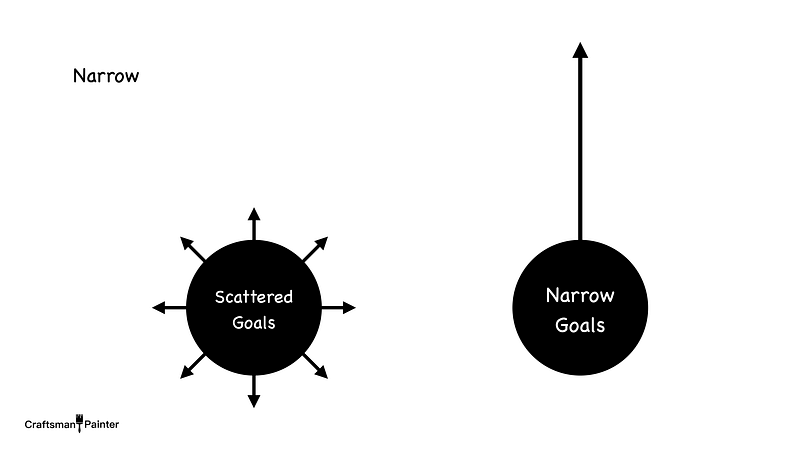
Focus on a specific, well-defined goal, avoiding overly broad or multifaceted objectives. It’s easy for our goals to become scattered and fragmented. Leaders and entrepreneurs are highly susceptible to having scattered goals. This is because the word creative describes them much better than having vision. The word visionary has never sat well in my stomach. Aside from its wildly narcissistic overtones, it just has never seemed accurate. I think vision is easily confused with ideation but with a flair for grandiosity and maybe delusion. But creative, I can get down with.
Creative more accurately depicts the process of the creation of new ideas and the excitement and energy required to go do it. Creatives are also capable of being their own integrators, which is mandatory in entrepreneurship. The problem with creatives is that our brain never shuts off, and we’re on to the next one faster than you can say Taylor S — . (If she marries Travis Kelsey, does that make this point moot? Or if she doesn’t will I just be dating this article?)
Creative leaders and entrepreneurs have to develop the discipline to get narrow and focused on a single goal and see it through to the end. There’s no wonder that many of history’s greatest artists were mostly broke their entire lives. DiVinci could do just about anything but manage money (Michelangelo on the other hand knew how to stack chips). Our creative minds relish in the new and struggle with the routine.
Unfortunately, narrow goals, singularly focused, become routine and therefore mundane. But as an organization, at some level, we have to focus on doing the mundane hyper consistently. It is in that narrow focus that we are able to produce something of such skill and quality that it becomes leaps and bounds more innovative than the competition.
In 1997, Apple was floundering, with an unwieldy product line that had become confusing for consumers and expensive to maintain. When Steve Jobs returned to the company as CEO, he recognized the need to drastically streamline their offerings.
During a presentation to employees, Jobs famously walked up to a whiteboard and drew a simple 2×2 grid. He labeled the rows “Desktop” and “Portable” and the columns “Consumer” and “Pro.” He then explained that Apple would focus its energy on only four products, one in each quadrant of the matrix:
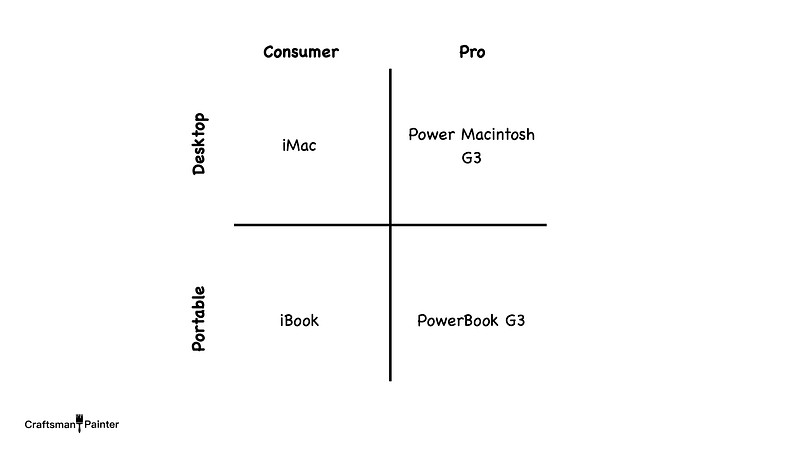
This radical simplification of Apple’s product line was met with skepticism by some, but it proved to be a masterstroke. By focusing their resources on a limited number of well-designed, high-quality products, Apple was able to regain its footing and eventually become the most valuable company in the world.
The 2×2 matrix story is a testament to Steve Jobs’ belief in simplicity, his ability to distill complex problems into their essence, and his unwavering focus on creating products that truly resonated with consumers. It’s a powerful reminder of the German phrase, “weniger, aber besser”. Translation: Less, but better.
Time-Bound
Set a clear deadline to create a sense of urgency and facilitate effective planning. This last piece is the thing that saves us creatives and for non-creatives without it, they’d sooner run their head through a brick wall. We all need deadlines. Otherwise, we end up with half-baked, unfinished products. Putting in place time-bound restrictions on your goals is another place where leaders have to develop the discipline muscle. Especially when you’re a solopreneur or in a work environment with high autonomy. It’s easy to forget deadlines when you don’t have a boss imposing them on you. But you’ve got to do it. Even if you have to find a third-party or friend to hold your feet to the fire.
Your timeframe has to reference most of the preceding words of the SPRINT acronym. The complexity of the specification may lengthen the timeframe of the goal. How many performance driving activities you’ll be able to perform have time limitations to them. The deadline you impose will determine if the goal is realistic or narrow enough. You could even argue that its importance would influence the priority level or sense of urgency that your team commits to the goal. The deadline, in many ways, makes or breaks the goal.
If you’ve read my book, you’ll know that in Agile a Sprint is a two week period that your whole team follows. I find it helpful to keep my SPRINT Goal deadlines aligned with the Sprint schedule. A two week deadline is great for small goals. For bigger goals, think of it in iterations of multiple Sprints.
So put a date on your calendar and several reminders between there, and have someone meaningful agree to hold you to the date.
By applying the SPRINT Goals framework, you can set goals that are not only ambitious, but also actionable and aligned with your overall business strategy.
Examples
Example 1: Setting Sales Goals Using SPRINT Goals
Let’s explore how to set effective sales goals using the SPRINT Goals framework:
Specifications:
- Goal: Increase residential painting sales by 15% in the next quarter.
- Requirements: Identify new target neighborhoods, develop a referral program, improve email lead generation strategies.
Performance Driven:
- KPIs: Number of new leads generated, number of quotes provided, conversion rate from quote to sale, average sale value.
- Performance Drivers: Number of networking events attended, number of referral partnerships established, emails & text messages sent.
Reachable:
- Analyze past sales data to determine if a 15% increase is realistic.
- Consider seasonal fluctuations and market conditions.
Important:
- Increased sales will lead to higher revenue, enabling the company to invest in new growth, expand services, and feed families.
Narrow:
- Focus specifically on residential painting sales, rather than trying to increase sales across all service lines simultaneously.
Time-Bound:
- Set a deadline for the end of the quarter to maintain focus and urgency.
Example 2: Setting Production Goals Using SPRINT Goals
Let’s see how SPRINT Goals can be applied to production goals:
Specifications:
- Goal: Reduce average project completion time by 10% without compromising quality.
- Requirements: Streamline communication processes, optimize scheduling, improve inventory management, invest in new tools or technology.
Performance Driven:
- KPIs: Average project completion time, number of projects completed on time and within budget, customer satisfaction ratings.
- Performance Drivers:
Pre-Project Planning: Time spent thoroughly reviewing project scope, materials, and potential challenges before starting.
Daily Huddles: Conducting brief team meetings each morning to align on daily tasks, priorities, and potential roadblocks.
Communication Efficiency: Tracking the average response time to client questions or concerns, aiming for prompt communication.
Proactive Problem-Solving: Number of proactive solutions identified and implemented to prevent delays or issues during projects.
Continuous Improvement: Number of suggestions made by team members for process improvements, tool upgrades, or efficiency enhancements.
Reachable:
- Analyze historical project data to determine if a 10% reduction is feasible.
- Consider the impact of external factors like weather conditions and seasonality.
Important:
- Faster project completion times will lead to increased customer satisfaction, improved reputation, greater profitability, and the ability to take on more projects.
Narrow:
- Focus on reducing completion time, rather than trying to improve all aspects of production simultaneously.
Time-Bound:
- Set a deadline for achieving the 10% reduction, ideally within a specific timeframe, like six months.
Example 3: Setting BNI Membership Growth Goals Using SPRINT Goals
Let’s see how SPRINT Goals can guide this goal:
Specifications:
- Goal: Increase BNI chapter membership by 25% within the next six months.
- Requirements: Develop a targeted visitor invitation strategy, enhance the chapter’s online presence, improve the visitor experience, create a structured onboarding process for new members.
Performance Driven:
- KPIs: Number of visitors per meeting, visitor-to-member conversion rate, number of new members, member retention rate.
- Performance Drivers:
Member Engagement: Number of one-to-one meetings held by each member per week, number of referrals given and received, active participation in chapter activities.
Visitor Outreach: Number of personal invitations extended to potential visitors, active engagement on social media platforms, targeted outreach to specific professions or industries.
Meeting Quality: Feedback surveys from visitors, number of testimonials shared by members, overall engagement and energy level during meetings.
Onboarding Success: Number of new members actively participating in chapter activities within the first month, number of referrals generated by new members within the first quarter.
Reachable:
- Analyze the chapter’s historical membership growth data.
- Assess the local market potential for new members.
- Consider the chapter’s capacity to onboard and support new members effectively.
Important:
- Increased membership will lead to a larger, more diverse network, more referral opportunities, and greater value for existing members.
- A thriving chapter attracts high-quality professionals and enhances the chapter’s reputation within the community.
Narrow:
- Focus on the specific goal of membership growth, rather than trying to improve all aspects of the chapter simultaneously.
- Target specific professions or industries to attract members who complement the existing expertise within the chapter.
Time-Bound:
- Set a clear deadline of six months to create a sense of urgency and facilitate effective planning.
- Break down the goal into smaller milestones to track progress and make adjustments as needed.
Conclusion
The SPRINT framework provides a versatile and effective tool for setting goals in the painting industry. By following this structured approach, you can ensure that your goals are not only ambitious but also achievable, relevant, and aligned with your overall business objectives.
Ready to transform your goals from aspirations to achievements? Download the SPRINT Goals Playsheet now and equip yourself with a proven framework for success. This comprehensive guide will walk you through each step of the SPRINT process, providing you with the tools and strategies you need to set clear, actionable, and impactful goals. Don’t just dream about your future — build it. Download the SPRINT Goals Playsheet today and start your journey toward lasting success.
Are you a painter on a lonely island trying to figure out all this business stuff alone? Come join the Craftsman Painter Collective and get 1 on 1 support, a host of digital tools, and playbooks to help you grow your business. We’re all in this together. Check out our website and subscribe to our YouTube channel and listen to the most recent episode of the PaintED Podcast where we talk about subcontractor management and conflict resolution with Dmitriy Ivanchuck, CEO and Co-Founder of Hey Pros.
 After
After Before
Visualize Your Space with Color Studio AI
Planning a project? Skip the paint chip guesswork. Use our Color Studio AI to instantly visualize these paint colors on your own walls, or take advantage of our aligned contractor pricing matching current Sherwin-Williams retail promotions.
Book Your Upcoming Paint Project
Craftsman Painter is now scheduling premium transformations. Secure your spot and elevate your property value.
Get an EstimateHelp Others Find Professional Color Insights
Share this story directly to your networks or copy the link to share with friends.